Two years ago, we built a small tool to solve one problem. It matched course descriptions to skills. Today, that tool has grown into a full platform that connects your learners with skill frameworks, job profiles and courses. SkillData maps the skills behind every course, role and learner.
This is the story of SkillData: how it started, and what it does for you now.
It started with a manufacturing problem
In 2024, the LCAMP project faced a specific challenge. Employers struggled to describe the skills they needed. Training providers struggled to match courses to industry demand.
Our answer was Skill Finder. You paste in a course description or job posting. It returns matching skills from ESCO (European Skills, Competences, Qualifications and Occupations), the EU’s classification of over 13,000 skills.
No manual tagging. No guesswork. Just a faster way to find the right skill.
LCAMP is where it started. It gave us a real problem, real users, and room to build a working prototype. We’ve since presented it at conferences and webinars across Europe and Africa.
The tool works in 28 languages – all 24 EU languages, plus Icelandic, Norwegian, Ukrainian and Arabic. It uses AI embeddings and semantic search to match meaning, not just keywords, so relevant results turn up even when the wording doesn’t match ESCO’s.
From a search tool to a skills mapping platform
Skill Finder proved something fundamental: skills, described well, are a shared language. So we kept building.
In 2025, we launched the Skill Framework Builder. It lets institutions and employers design their own skill frameworks from scratch, or link them to existing ones like ESCO.
Earlier this year, as LCAMP wrapped up, we added job profiles and qualifications, described in the same skill terms as your courses.
Then came the Learner Portal. It opened SkillData beyond admins and course leaders — learners themselves can now upload their CV, run an AI-assisted self-assessment, and build their own skill profile. From there, you can see which job profiles fit you, and get personalised upskilling recommendations.
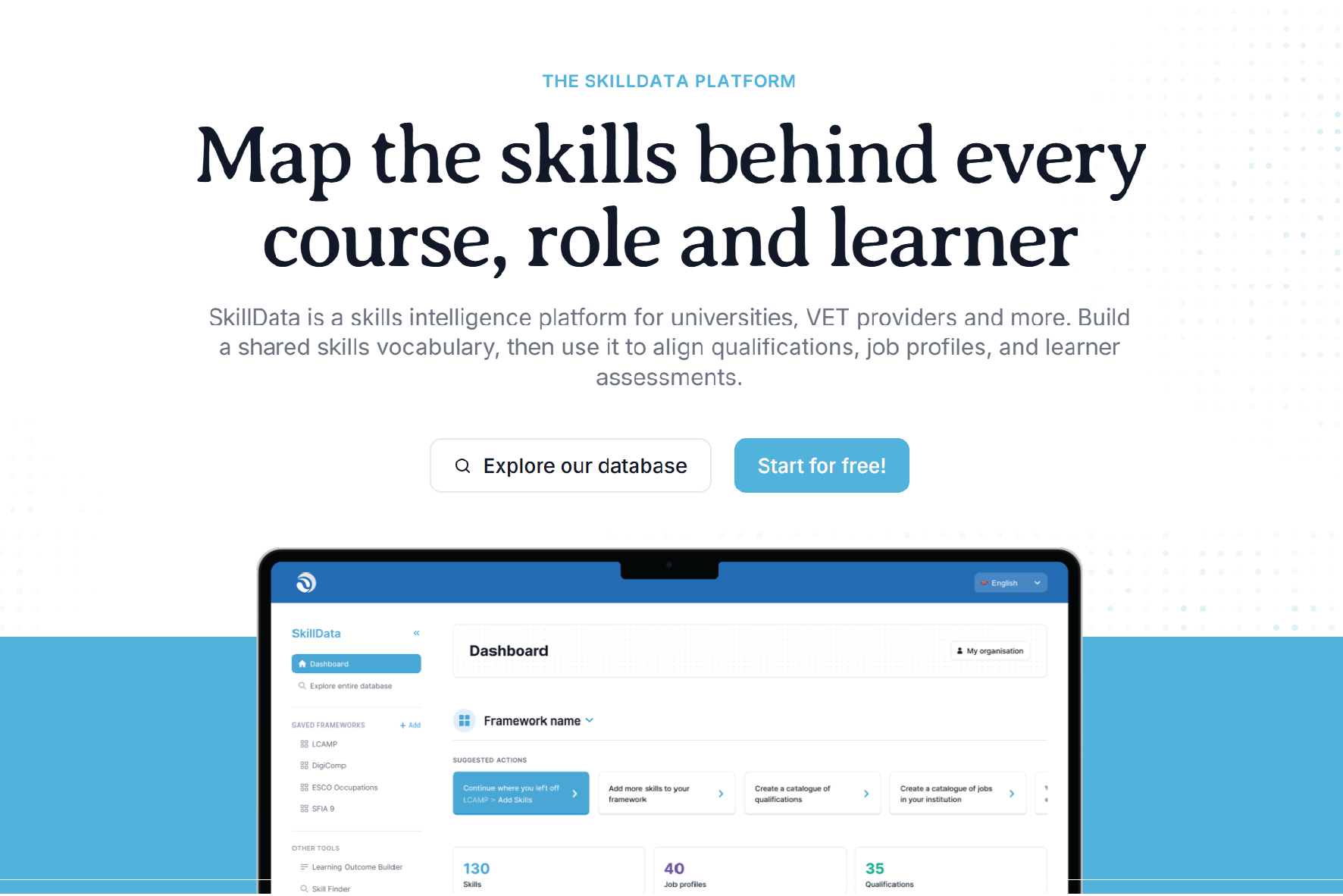
In June 2026, we rebuilt SkillData’s interface and architecture from the ground up, and gave it a name that says what it does: The SkillData Platform — map the skills behind every course, role and learner.
Together, these tools now form the SkillData suite: a skills platform for universities, VET providers, and workforce teams. One shared framework connects your courses, job profiles and learners.
Built to plug into everything else
None of this is much use if it stays locked inside SkillData. So we’ve built it to work with the standards your other systems already use.
In 2025, we mapped DigComp 3.0, the EU’s digital skills framework, to the global Rich Skill Descriptor (RSD) standard. SkillData can now export all frameworks in RSD format. Since 2026, it also supports the 1EdTech Competency and Academic Standards Exchange (CASE) standard. Every published framework in SkillData is accessible via a CASE 1.1 interface.
We’re also part of QualityLink, a project aggregating learning data from institutions across a European Universities alliance. It uses key European standards for course and programme data: ELM and OEAPI (formerly known as OOAPI) are ready today, with Edu-API and OCCAPI support on the way. The QualityLink aggregator can map courses and programmes to skill frameworks, so they can appear in SkillData too.
The Course Mapping Tool takes a free-form course description and turns it into ELM-ready data, with learning outcomes written in line with the latest Cedefop guidance – so it’s ready to plug into any ELM-based system without manual reformatting.
Our interoperability interfaces – RSD, CASE, ELM – let you connect other systems to SkillData, or have SkillData tap into your existing course catalogues.
This year, we presented SkillData to Europe’s digital learning community at the MCMC 2026 conference in Amsterdam and the EDEN 2026 conference in Porto. Our message was simple: skills data and course design belong together.
Earlier, in Murcia, our team worked with five European universities on the CREDIPILLS project. Together, they turned broad skills into ESCO-aligned learning outcomes, using SkillData – live, in the room.
What you can do with it today
With SkillData, you can:
- Build a custom skills framework from scratch, or browse existing frameworks for inspiration, e.g. SFIA or DigComp 3.0
- Generate learning outcomes from a course description, following Cedefop’s short learning outcome guidelines
- Create job profiles that define skills and proficiency levels, not just job titles
- Run AI-assisted CV analysis and self-assessments that map learners’ skills to your framework with the Skill Profiler
- Match learners to job profiles and course recommendations, automatically
- Give learners a skills dashboard, so they can see job matches and upskilling opportunities at a glance
Say a learner uploads a CV. SkillData’s Skill Profiler reads the information and identifies skills and qualifications. It then assesses proficiency using an AI-assisted self-assessment. It compares the learner’s skills against the framework and the defined job profiles.
Then it shows the learner which job profiles fit them, and which courses would close the gaps to their desired career path.
Who it’s for
Universities and VET providers build skill frameworks for their programmes and qualifications. SkillData generates well-described learning outcomes without the manual work. A course leader can turn a free-form module description into rich, structured data, aligned with ELM and learning outcomes guidance, in minutes.
EU project consortia use SkillData to manage shared skills vocabularies across partner institutions. Partners in different countries can describe skills in the same way, even when their systems don’t match.
HR and workforce teams define job profiles in skill terms, not job titles. A role description becomes a list of skills and levels. Then they design upskilling pathways that close specific gaps.
Built with LCAMP and QualityLink, grown by our team
SkillData started inside the LCAMP project. LCAMP helps regional manufacturing centres upskill people for the digital and green transitions. It connects training centres and companies to close skill gaps in the industry.
Skill Finder became one of the tools that made this possible. It’s now open to any organisation working with skills.
QualityLink connected SkillData to major European data standards for course and programme data.
A small team builds and runs it. Aljaž Leben is our project manager. Rok Mlakar builds the platform. Domen Bevec designs the user experience.
SkillData is part of a bigger push. We’re a member of the European Commission’s Pact for Skills. Together with others, we’re working to close skills gaps across Europe.
Try it yourself
You can explore the public database without an account.
Want SkillData for your organisation? Email info@knowledgeinnovation.eu to book a demo, and we’ll help you get set up.