

What does a modern adult learning system actually look like? Not in theory but as something you can click through, explore, and critique.
That question led us to create the RALExILA prototype. It shows how an integrated Adult Learning and Education (ALE) registry can work with an Individual Learning Account (ILA) system.
From model to screen
We spent two years researching how countries across Europe can improve access to adult training. We mapped capabilities, analysed good practices, and developed a shared system model. But when you’re designing something as complex as a national registry, words and diagrams only go so far.
So our technical team at KIC built a Figma prototype – not as a finished product, but as a validation exercise. We wanted to test whether our system model held up when handed to a developer who understood technology but not necessarily adult learning policy. It did.
Grounded in research and co-design
The prototype didn’t come out of nowhere. It’s built on a capability map developed through extensive research and co-design with those same stakeholders.
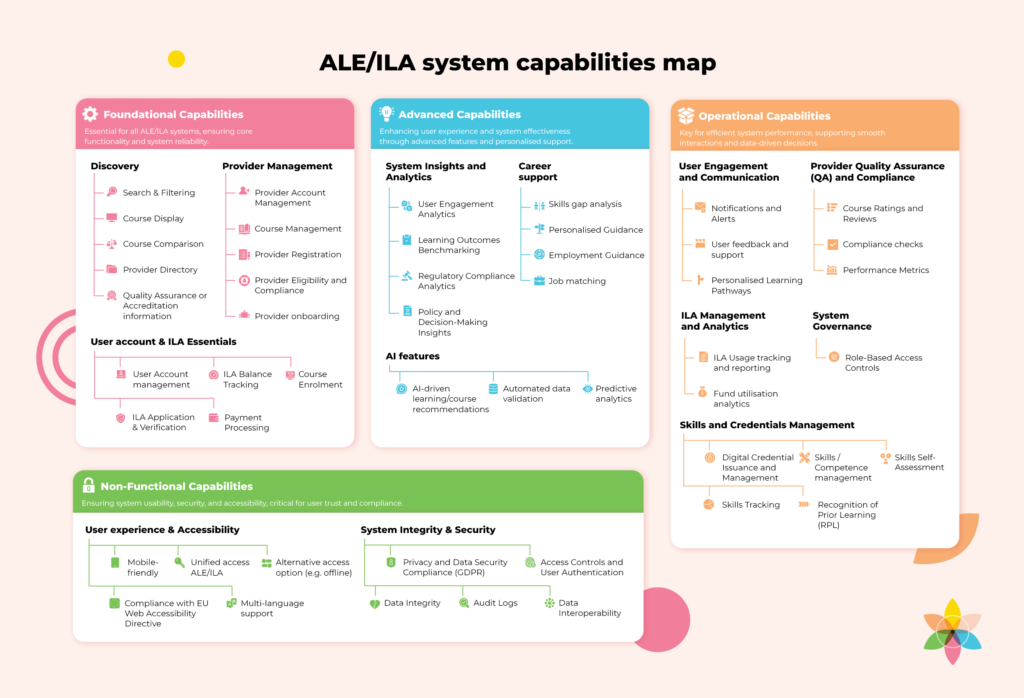
That map identifies the features any ALE/ILA system needs – from basic course discovery and provider management through to skills tracking, digital credentials, and funding oversight. The prototype turns those capabilities into screens a real user can navigate.
What the prototype shows
The prototype walks through the full learner journey – from discovering courses to managing funding.
On the course catalogue, learners can filter and browse learning opportunities that are structured consistently across sectors and providers. Each course links to learning outcomes and competences mapped to ESCO, supporting personalised pathways and Recognition of Prior Learning (RPL).
The provider area tackles one of the trickiest parts of any ALE registry: who gets listed, and how do learners know they can trust them? The prototype keeps it simple – providers are either verified or not – while acknowledging that real national systems will handle this in their own way.
The ILA section gives learners a transparent view of their funding: types, balances, restrictions, and transaction history. A small feature with big implications for learner trust and system uptake.
Finally, the achievements section captures what learners have earned – micro-credentials, certifications, and other recognitions – all linked back to competences, ready to feed into skills gap analysis and future recommendations.
Why this matters
The prototype demonstrates something important: the RALExILA System Model isn’t just a research output. It’s a blueprint that translates directly into real system design. Every screen corresponds to capabilities and data structures defined through research and stakeholder co-design across Europe.
Countries building or upgrading ALE registries can use the model – and now this prototype – as a practical starting point.
A quick note on the prototype: for the best experience, select Fit width from the display options in the top-right corner of the Figma viewer once it loads.
About RALExILA
RALExILA is a European project developing a shared model for national ALE registries – the systems that help learners find quality-assured courses, manage learning funding, and track what they’ve achieved. The project brought together over 20 national authorities and 40 ALE organisations across Europe, combining research, co-design workshops, and direct stakeholder input. Its main outputs include a handbook for national registries and an interoperable system model aligned with European standards.
About the authors